
In the world of industrial piping, the importance of proper pipe support design cannot be overstated. Whether in petrochemical refineries, power plants, offshore platforms, or modular process skids, the structural integrity and operational reliability of a piping system rely heavily on its support infrastructure. Adjustable pipe supports play a critical role in providing the flexibility required to accommodate field-level variances, thermal expansion, structural tolerances, and dynamic load conditions.
At Cogbill Construction, we manufacture a wide range of high-performance pipe supports under our RedLineIPS brand, including adjustable pipe supports tailored for precision, strength, and field usability. This article provides an overview of the engineering design principles behind adjustable pipe supports—exploring mechanical fundamentals, material selection, standards compliance, and real-world performance criteria.
What Are Adjustable Pipe Supports?
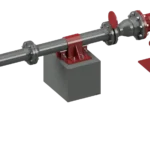
Adjustable pipe supports are mechanical assemblies designed to support the weight of a pipe while allowing for fine-tuned height or positional adjustment. They are frequently used where:
- Piping elevation must be leveled on uneven foundations,
- Modular systems require field alignment,
- Thermal expansion causes movement or stress,
- The load-bearing structure varies in tolerance.
Adjustability mechanisms include threaded rod assemblies, jacking screws, leveling plates, and sliding shoes, depending on application and orientation (vertical, horizontal, or inclined).
Load Calculation Fundamentals
-
Types of Loads to Consider
Any adjustable pipe supports system must be designed to handle:
- Dead Load (DL): Weight of the pipe + insulation + contents (e.g., water, oil, gas).
- Live Load (LL): Variable load due to flow dynamics or personnel interaction.
- Thermal Loads (TL): Induced by expansion or contraction.
- Seismic or Wind Loads (SL/WL): Particularly relevant in outdoor or offshore facilities.
- Dynamic/Impact Loads (DYL): Resulting from vibration, pump startups, valve closure (water hammer).

- Basic Load Formula Example (approximate): For a 10" carbon steel pipe, with water content and 2” of insulation:
- Pipe weight per foot = ~40 lb
- Water = ~25 lb/ft
- Insulation = ~10 lb/ft
- Total Dead Load ≈ 75 lb/ft
- Multiply by span to get total support load.
Each adjustable support is then designed to handle this load with a safety factor (commonly 3.0 to 5.0 depending on code).
Material Selection and Structural Design
- Structural Materials At RedLineIPS, we primarily use:
- ASTM A36/A992 Carbon Steel – for general service
- ASTM A240 304/316 Stainless Steel – for corrosive or clean service environments
- Carbon Steel with HDG or Coatings, and FRP Options – for specialized needs (though not typical in adjustable supports)
- Mechanical Design Aspects
- Threaded Rods and Bolts: Sizing must match thread engagement and axial load limits.
- Baseplates: Designed for uniform pressure distribution on foundations or steel beams.
- Adjustability Range: Typically ±2" to ±6" vertical travel; lateral adjustment achieved via slotted holes or sliding mechanisms.
Stress concentration at adjustment interfaces is addressed through:
- Chamfered transitions
- Increased weld throat size
- Use of bushings or washers to spread load
Compliance with Industry Standards
Adjustable pipe supports must comply with a range of industry standards, which vary depending on industry and region:
Standard | Coverage |
ASME B31.1/B31.3 | General piping code requirements |
MSS-SP-58 | Types and dimensions of pipe hangers/supports |
MSS-SP-69 | Recommended practices for pipe supports |
ASTM/AISC | Structural steel properties and performance |
NACE MR0175 / ISO 15156 | Material selection for sour service |
ISO 1461 | HDG coating thickness (if galvanized) |
Engineering Considerations in Real Applications
- Modular Skid Integration
Adjustable pipe supports enable precise leveling of skids during field assembly. This prevents:
- Undue stress on flange connections,
- Misalignment of pumps or nozzles,
- Excessive axial load from frame distortion.

- Thermal Alignment Support
In high-temperature services (e.g., steam at 400°F+), pipes expand linearly. An adjustable support allows hot or cold alignment tuning to match expected growth direction, especially where expansion loops or bellows are installed.
ΔL=α⋅L0⋅ΔT
Where:
- α = Thermal expansion coefficient (e.g., 6.5×10⁻⁶ in/in/°F for steel)
- Lo = Original length
- ΔT= Temperature change
A 100-foot carbon steel line at 400°F rise can expand over 3 inches — improperly fixed supports will cause flange bending or joint failure.
Support Types and Mechanisms
Common RedLineIPS Adjustable Pipe Support Styles:
- Adjustable Pipe Shoes – Slotted base, jacking bolts, for insulated or uninsulated lines
- Riser Clamp Assemblies – Vertical adjustability in structural support towers
- Base-Mounted Supports with Jacking Nuts – Ideal for structural steel foundations
- U-Bolt and Clevis Rod Supports – Allow vertical adjustment without full removal
All are available with:
- HDG (Hot-Dip Galvanized) finish
- Stainless Steel (SS304, SS316)
- Custom powder coat or epoxy coatings
Fatigue, Vibration, and Long-Term Load Behavior
Adjustable pipe supports are sometimes assumed to be static — but in reality, they endure:
- Pulsating loads (from pumps, compressors)
- Cyclic thermal expansion/contraction
- Equipment startup and shutdown transients
Thus, engineers must account for:
- Thread loosening risk — solved with locking mechanisms
- Fretting fatigue — mitigated via PTFE slide pads or wear-resistant liners
- Settlement — minimized with baseplates sized for foundation class
Field Fit-Up Benefits:
- Tolerances in civil or steel elevation can be corrected on-site
- Reduces need for shims or torch trimming
- Greatly simplifies pipe-to-structure connection in brownfield retrofits
Installation Guidance:
- Tighten adjustment nut under load, then lock
- Torque per applicable bolt/nut specifications (e.g., ASTM A563 / A325 and manufacturer recommendations)
- Check vertical plumb (±2°)
- Use grout or bearing plate if uneven concrete
RedLineIPS provides pre-calibrated adjustment guidelines for installers to ensure consistent setup and structural reliability.

Common Mistakes and How to Avoid Them
Mistake | Solution |
Overloading the adjuster threads | Follow RedLineIPS load chart limits |
Misalignment of baseplates | Use leveling shims or laser layout |
Overtightening against pipe growth | Use expansion shoes or guides |
Inadequate anchorage to steel/concrete | Use Hilti or mechanical anchors rated per load class |
Conclusion
Adjustable pipe supports are more than just hardware — they are engineered solutions for variability, thermal behavior, and field challenges in industrial piping. At Cogbill Construction, every RedLineIPS adjustable support is built on the core principles of:
- Mechanical integrity
- Code compliance
- Field practicality
- Longevity under real-world loads